1. democratic principles
The Declaration of Independence outlines basic democratic principles, or unalienable rights, that the new nation was going to uphold. All men are created equal and all men have the right to life, liberty, and the pursuit of happiness. It states that governments are created in order to secure these rights among the people. The government derives it's power from the "consent of the governed." This means that the people give up some of their rights in order to be governed. If a government becomes too catastrophic, it is the right of the people "to alter or to abolish it, and to institute new government."
2. list a handful of grievances
He refused to approve laws necessary for the public good and repeatedly dissolved representative houses. He quartered large bodies of armed troops, cut of trade with the rest of the world, and took away many charters. He protected the quartered troops from any punishment for murders they committed while in the colonies. He plundered their seas, burned their towns, and destroyed the lives of their people. He taxed without their consent.
3. the conclusion
The conclusion sums up that the colonies have constantly reminded Britain about why they emigrated to the New World, most of them did so for more freedom. Despite the warnings, the British ignored the colonist's pleas. They go on to state that the representatives of the United States of America, in the General Congress, declare that they ought to be "free and independent states." They relieved themselves from all allegiance and any political connection to the British crown.
"...we mutually pledge to each other our lives, our fortunes, and our sacred honor."
1. Who was John Peter Zenger?
John Peter Zenger was an immigrant to New York City from Germany. In 1733, he began a publishing company to voice his opposition and criticize the policies of the New York governor, William Cosby.
2. What was the controversy over his charges?
Talk about Hamilton's defense.
Zenger was arrested for libel, publishing a false statement that is damaging to someone's reputation. His lawyer for trial was Alexander Hamilton. Hamilton admitted that Zenger published offending stories about the governor, but since they were not false, he could not be charged for libel.
3. What influence did his case have on American
governmental tradition?
This set the stage for the First Amendment, adopted in 1791, and included the freedom of the press. This allows people to publish and voice their opinions without having to go on trial or be arrested. If it is true it is not illegal.
4. What is the lasting significance of his
trial? Explain.
This trial proved very important to the future country that they were on the brinks of creating. In the United States of America we have the opportunity to speak our minds, voice our opinions, and even publish things, if they are true. In other countries, North Korea and Communist Russia to name a few, they regulate the press and news sources aren't free to speak out for their beliefs.
1) What concepts are included in the Mayflower Compact? Those who traveled to the New World on the Mayflower stated that "having undertaken for the Glory of God...plant the first Colony." It is apparent that they are very religious and include their odes to God in the Compact. This is important to note this because the reason the pilgrims traveled to the New World was because of religious persecution. In this new world they had the freedom to go about their religious life as they wish. They also state that they will organize themselves into a "civil Body Politick" or a governing system to keep order in the new colony. They agreed to live under different laws and acts of the governing body for the greater good of the colony.
2) How does the Mayflower Compact reflect and attachment to both the "Old" and "New" worlds?
The Mayflower Compact reflects the pilgrim's attachment to the "Old" World because they state that they had taken this new journey in the "Honour of our King and Country." This shows that they still view themselves as Englishmen and part of the British Empire, not an independent group. The Compact also reflects many new ideas of the "New" World. They agree to live for the greater good of the people and under the new laws and agreements that will be set in places. They have the ability to govern themselves, free from the monarch and Parliament, a new concept to the British.
3) How did the Fundamental Orders of Connecticut differ from the Mayflower Compact?
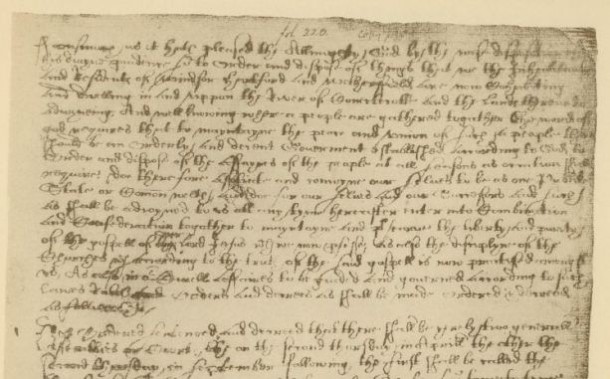
The Fundamental Orders of Connecticut were a more detailed version of the Mayflower Compact. They drew up specifics about how they were to run their new government in the "New" World and how to select a governor. They outlined how voting works, the requirements of the governor, and how often they can vote. The Mayflower Compact was very simple, stating that they were no longer under the control of the monarch and how they wished to run their government in the future.
4) What prompted the colonists of Connecticut to take this approach to government, i.e.: use of a written Constitution?
The colonists of Connecticut realized that they were technically no longer under the control of the monarch, as did the pilgrims, and used their skills to create a written constitution and outline what the new government would be like in their colony.
5) In what significant way(s) does the Fundamental Orders reflect a fear of and safeguard against the usurping of power by one person or a chosen few?
The Fundamental Orders included a great deal about how voting was to work, how often one can vote, and the requirements of the governor. This reflects the Connecticut colonists fear of a single person with all the power, or a chosen few, running the government. They had just come from England where there was a monarch with King James running the show. In order to not recreate the environment they had just fled from they had to clearly state how they were to choose a leader in their new colonies.
The Fundamental Orders of Connecticut
Creating the Mayflower Compact